
Workshop on Health Taxes: country experiences and best practices in policy design and implementation
Co-organised by the ATI and the World Health Organization (WHO)
Background
The COVID-19 pandemic highlighted the deep interconnection between public health, economic stability, and fiscal resilience. Many countries emerged from the crisis with constrained fiscal space, rising public debt, and weakened health systems, underscoring the urgent need for sustainable and predictable health financing and stronger pandemic preparedness.
Universal Health Coverage (UHC), enshrined in Sustainable Development Goal (SDG) 3, remains central to building resilient societies and inclusive economies. Yet progress toward UHC has stalled. At the same time, official development assistance (ODA) for health is declining, reinforcing the need for strengthened domestic resource mobilisation (DRM).
In this context, health taxes - particularly excise taxes on tobacco, alcohol, and sugary drinks - offer a powerful yet underutilised policy tool. When well designed, they can reduce the burden of non-communicable diseases (NCDs), expand fiscal space, support sustainable health financing, and contribute to broader DRM and development objectives. Their importance was reaffirmed in the Compromiso de Sevilla adopted at the Fourth International Conference on Financing for Development (FFD4) and operationalised through WHO’s “Accelerating Health Taxes: The 3 by 35 Initiative”.
Despite strong evidence of their health and revenue benefits, health taxes remain underutilised in many countries due to industry interference, equity concerns, administrative capacity constraints, and limited cross-sectoral coordination between ministries of finance and health. Nevertheless, some country experiences demonstrate that well-designed reforms can significantly increase revenues, improve health outcomes, and enhance public acceptance.
Against this backdrop, evidence-informed dialogue can support countries in advancing effective health tax reforms through sound technical design, strong inter-ministerial coordination, political leadership, and strategic public communication.
Objectives
The overall objective of the workshop series is to strengthen country capacity and political commitment to design and implement effective, equitable, and sustainable health taxes as part of broader health financing strategies for UHC.
Specific objectives are to:
- Enhance understanding of the role of health taxes in advancing UHC, reducing NCDs, and expanding fiscal space;
- Share country experiences on health tax design, implementation, and governance;
- Address political economy challenges and opposition narratives;
- Foster cross-sectoral dialogue among health, finance, and tax authorities, as well as civil society;
- Support alignment with global commitments, including FFD4 outcomes and WHO’s 3 by 35 Initiative.
Format and target audience
The workshop series will consist of four thematic sessions delivered over two days in a virtual format. Each session will combine expert inputs, country case studies, and interactive exchanges structured as a policy journey from evidence to implementation and commitment.
The workshop will bring together:
- Policymakers and technical experts from ministries of finance and tax authorities from ATI partner countries;
- Representatives of ATI development partners and supporting organisations;
- Other interesting government representatives invited by the partner organisations, including representatives from ministries of health.
Agenda
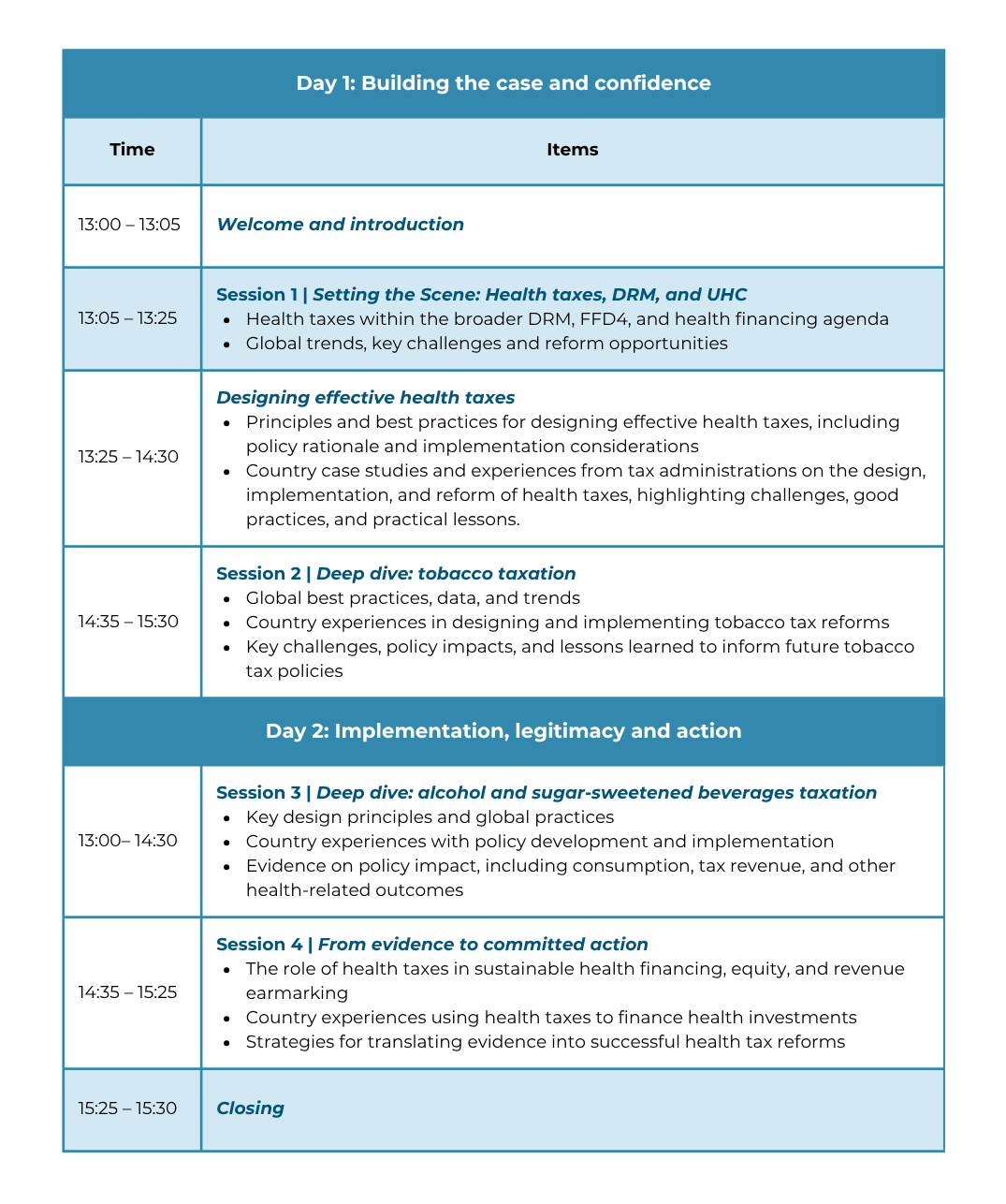
For speakers information please refer to the programme linked above.
Logistical information
The workshop will be conducted virtually via Microsoft Teams. The workshop will be held in English, with simultaneous interpretation into French and Spanish.
Following the event, the ATI would encourage continued work in this area and potential bilateral support from its members and the WHO to partner countries interested in implementing health taxes at the national level.