10th meeting of the Community of Practice on Tax Expenditures
Special Economic Zones (SEZs) and the role of tax incentives
The Addis Tax Initiative (ATI), together with the Council on Economic Policies (CEP) and the German Institute of Development and Sustainability (IDOS) — the partners behind the Tax Expenditures Lab — have been cooperating to strengthen the transparency, governance, and effectiveness of tax expenditures (TEs) worldwide. The Tax Expenditures Lab is responsible for the Global Tax Expenditures Database (GTED) and the Global Tax Expenditures Transparency Index (GTETI), two key tools that provide comprehensive data and showcase good practices in TE reporting, evaluation, and management.
Together, the ATI and the Tax Expenditures Lab partners have conducted a series of workshops on TE policy and administration for finance ministries, revenue authorities, and parliamentarians, to build capacity, foster knowledge sharing, and develop regional networks of experts in the field. These efforts aimed to strengthen institutional capacities to report, evaluate, and reform TEs effectively, supporting evidence-based and transparent policies in the field and contributing to broader domestic revenue mobilisation (DRM) efforts. Building on this momentum, the Community of Practice (CoP) on TEs was established as a sustained platform for exchange, enabling stakeholders to leverage collective expertise and improve TE governance and management across institutions.
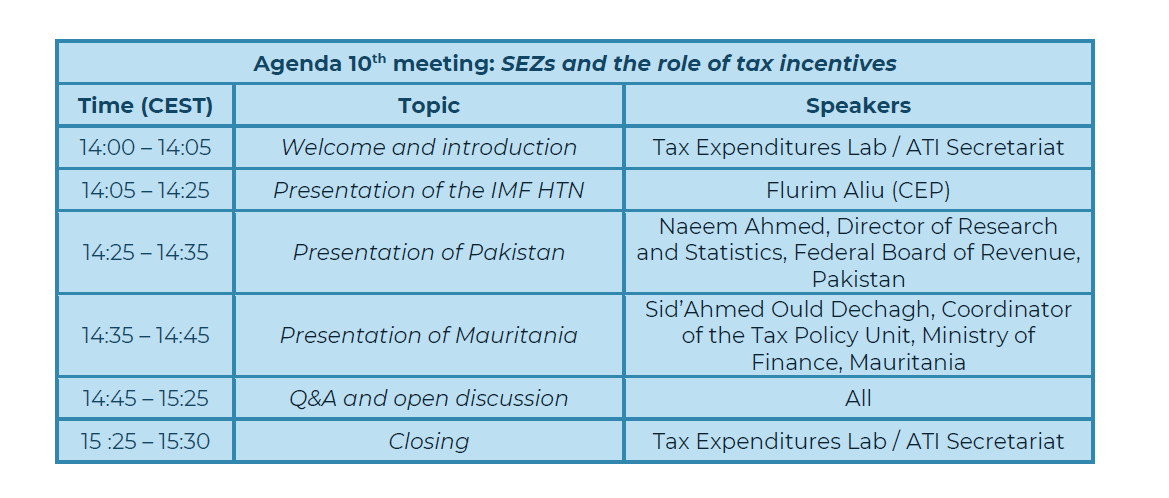
The 10th virtual CoP meeting will focus on Special Economic Zones (SEZs) and the role of tax incentives. The session will explore the use of tax incentives in SEZs, drawing on international evidence, practical guidance, and country-level experience. The recently published IMF How-To Note (HTN), Special Economic Zones and How to Tax Them, will provide the basis for a discussion of international evidence and practical guidance. This will be complemented by country presentations from Pakistan and Mauritania, sharing their experiences with the design and implementation of SEZs, the use of tax incentives within them, and the implications for investment and domestic revenue mobilisation.