
Cryptocurrency solidarity levies: Taxing crypto-assets for climate and development
A joint ATI–GSLTF webinar presenting the recommendations of the International Expert Commission on Crypto Asset Levies for Climate & Development, exploring how crypto-asset levies can strengthen domestic revenue mobilisation while supporting climate and development objectives.
On 13 July the Addis Tax Initiative (ATI) and the Global Solidarity Levies Task Force (GSLTF) convened a joint webinar on cryptocurrency solidarity levies, held online and by invitation only under Chatham House rules. Opened by Brice Roinsard of the GSLTF, the session presented the findings of the International Expert Commission on Crypto Asset Levies for Climate & Development, which the GSLTF commissioned a year earlier and whose work is set out in the report Toward a Crypto Solidarity Levy. With crypto-asset market capitalisation estimated at USD 3.7–4 trillion in August 2025, and recent advances in international tax transparency — notably the OECD’s Crypto-Asset Reporting Framework (CARF) — opening new avenues for oversight, the discussion set out to build understanding of the available levy options and their potential contribution to Domestic Resource Mobilisation (DRM), tax fairness, and climate and development finance. The presentation was structured around three questions, delivered by three members of the Commission:
- Why crypto taxation has become a mainstream policy issue
- How CARF and CRS 2.0 make enforcement more realistic
- Which domestic approaches governments can adopt now
Why crypto taxation has become a mainstream policy issue
Tatiana Falcão, Coordinator of the Commission, opened by explaining why crypto taxation is no longer a niche concern. Crypto functions both as a store of value and as part of payment infrastructure, including for remittances and cross-border transfers, while stablecoins increasingly operate like global payment systems.
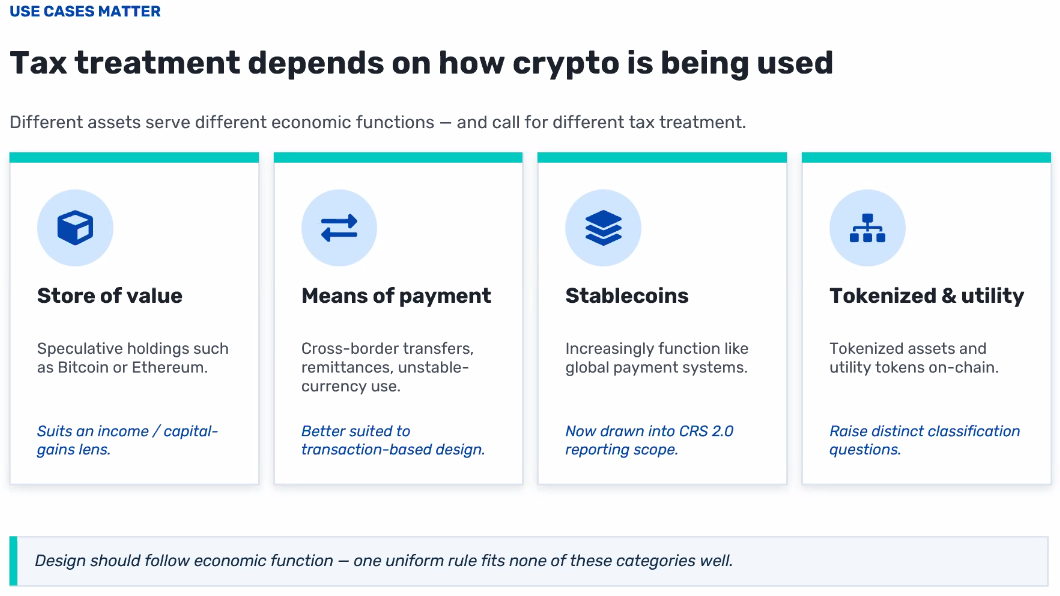
Governments, she noted, are trying to balance four goals at once:
- Enabling innovation
- Protecting financial stability
- Countering illicit use
- Protecting consumers and investors
No single instrument satisfies all four, so the design must reflect national priorities and capacity. She also sought to separate myths from realities: not all crypto is the same, and the environmental concern in particular is not uniform but concentrated in energy-intensive proof-of-work systems (such as Bitcoin), as opposed to the far less energy-intensive proof-of-stake model that now underpins most other assets. This argues for differentiating between technical models rather than taxing all crypto alike. The recurring theme, however, was that the hardest problem has never been legal design but enforceability: rules can exist on paper yet fail in practice where administrations cannot see the activity they are meant to tax, given heavy reliance on self-reporting and fragmented visibility across offshore platforms and self-hosted wallets.
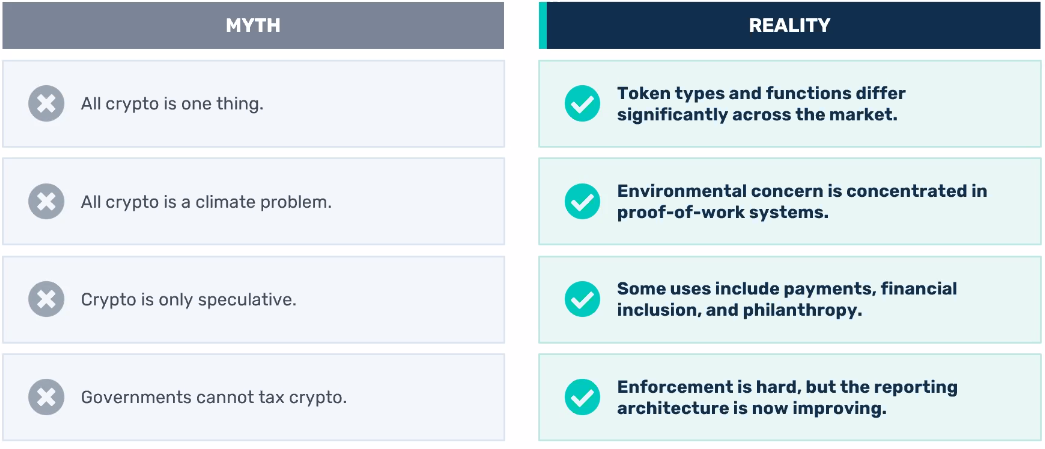
How CARF and CRS 2.0 make enforcement realistic
Max Bernt, Managing Director Taxbit APAC & EMEA, addressed the enforcement backbone. He traced the transparency build-out in the past 15 years from the United States Foreign Account Tax Compliance Act (FATCA) regime, through the OECD’s Common Reporting Standard (CRS) for traditional financial accounts, to the Crypto-Asset Reporting Framework (CARF) and CRS 2.0, which extend automatic exchange to digital assets.
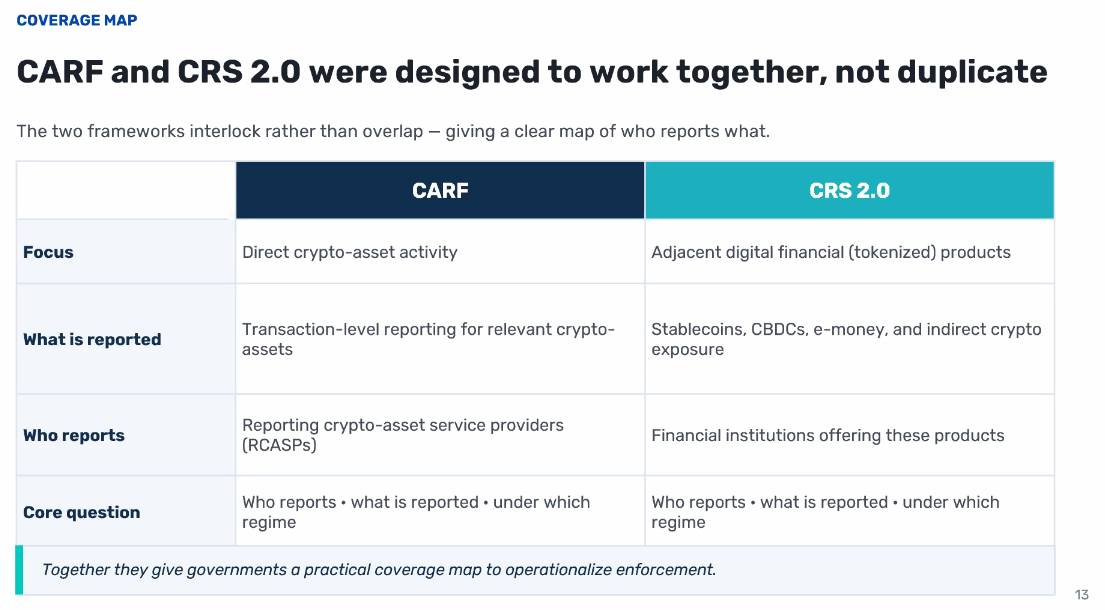
A central point was the limit of on-chain analytics: while blockchains are often assumed to be fully traceable, off-chain traceability is the real challenge. Once assets move into a self-hosted wallet, visibility is lost. CARF is becoming a global reporting standard, with more than 70 jurisdictions transposing it or equivalent pathways on staggered timelines and two large adoption waves expected in 2027 and 2028. Several jurisdictions where crypto-asset service providers are commonly incorporated (including the UAE, Seychelles, Singapore, and Switzerland) fall within the second wave. He explained that CARF and CRS 2.0 are designed to interlock rather than duplicate: conventional fiat currency falls under CRS, while assets such as stablecoins (for example, Tether) are captured by CARF, including wallet-to-wallet stablecoin transfers. Crucially, CARF does not itself determine how much tax an individual owes: It is a risk-assessment tool that helps administrations identify who warrants closer scrutiny. Remaining gaps such as peer-to-peer activity, DeFi structures, and self-hosted wallets mean international reporting must still be complemented by domestic law and supervision.
Domestic tax approaches that governments can adopt
Noam Noked, of the Faculty of Law at the Chinese University of Hong Kong, set out the domestic policy menu: levies on crypto income and gains, transaction-based levies, levies on crypto-asset service providers (CASPs), and environmental levies targeting proof-of-work mining. Each raises different issues of neutrality, nexus, enforceability, and coordination, and enforcement remains the binding constraint because a direct transfer that bypasses an exchange is difficult for tax authorities to observe. On neutrality, he argued that where a jurisdiction taxes profits, crypto profits should be taxed on the same basis, while flagging the open question of how to treat the losses that many crypto holders have incurred, whether these should be offset against all income or only against crypto gains. Drawing on emerging country practice including India’s withholding-style deduction at source on crypto transactions, Brazil’s application of its IOF tax in certain crypto-related foreign-exchange situations, and the experience of Denmark and Norway in linking transaction data to taxpayer identity, the report’s benchmark direction is a low-rate crypto transaction levy with an environmental overlay, applying a higher rate or add-on to energy-intensive proof-of-work activity. Across every option, strong third-party reporting is critical, as all models weaken when they rely on self-reporting alone.
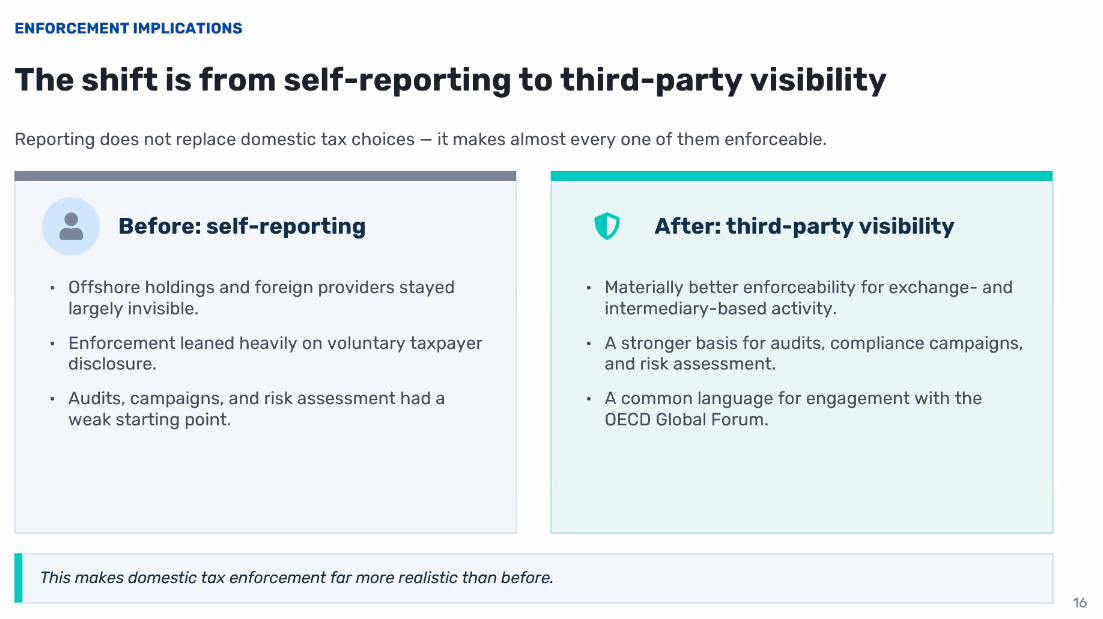
Three recommendations governments can act on now
The Commission closed with three practical steps governments can take even before designing a full crypto tax system:
- Define crypto-assets in domestic law, including tax definitions where these are not yet in place
- Join CARF to gain enforcement visibility and access to OECD Global Forum expertise
- Issue clear public guidance on how crypto is taxed, so that taxpayers understand the rules and cannot claim ignorance.
These foundations can be advanced in parallel with, rather than after, calibrating the levy itself to local objectives, capacity, and risk appetite.

Open discussion
The discussion focused on how developing countries in particular can approach the issue. The participants asked what the most realistic entry point and sequence would be, the presenters suggested beginning with a prudential regulatory baseline for crypto-assets by establishing how to engage with service providers operating in the country, along the lines of the European Union’s Markets in Crypto-Assets Regulation (MiCA), followed by building visibility through clear legal definitions, including a distinction between stablecoins and other crypto-assets and an understanding of what backs them, and by communicating clearly to the public that crypto-assets are taxable. They emphasised that these steps need not be strictly sequential: enacting legislation and joining international frameworks can proceed in parallel. On the specific question of how stablecoins should be taxed, the response drew a practical line: where there is visibility into the issuance of a stablecoin, it can be treated like electronic money, whereas where this is not clear in practice, it would be treated as a regular crypto-asset.
Closing and next steps
In closing, the session closed with the reflection that crypto taxation is no longer a purely conceptual debate: with the international reporting architecture now arriving, domestic enforcement is becoming far more realistic, and the question is shifting from whether crypto can be taxed to which approach best fits a country’s objectives and capacity. The organisers noted that the ATI and GSLTF will explore opportunities for continued engagement, including related events and potential support to partner countries interested in implementing solidarity levies.
Please find the presentation here