Challenging royalty payments in transfer pricing through the Andhra Paper case
The first webinar in the ATI series on good practices in combatting abusive transfer pricing, presenting the Indian case Andhra Paper Limited v. ACIT on trademark royalty payments, with a presentation by the South Centre and moderation by the Zambia Revenue Authority.
On 2 July the ATI held the first webinar in its new series Good practices in combatting abusive transfer pricing, gathering roughly 50 participants provided in English and French interpretation. The series falls under Action 3 of the Seville Declaration on DRM, by which ATI members commit to strengthening enforcement capacity and coordination to combat tax-related illicit financial flows, and continues the ATI's peer-learning work on audit practices and transfer pricing enforcement. It built on the November 2025 webinar with the Zambia Revenue Authority (ZRA) on the Nestlé Zambia case.
The session was moderated by Fanwell Chibwe, Assistant Director for Litigation and Corporate Advisory at the ZRA, and featured a presentation by Anne Wanyagathi Maina, Research Consultant on Tax at the South Centre. After a brief recap of the lessons learned from the ZRA/Nestlé case on enforcement, the discussion turned to the first case study of the series: India.
The case: Andhra Paper Limited v. ACIT
Andhra Paper Limited v. ACIT decided December 2025.
Situation
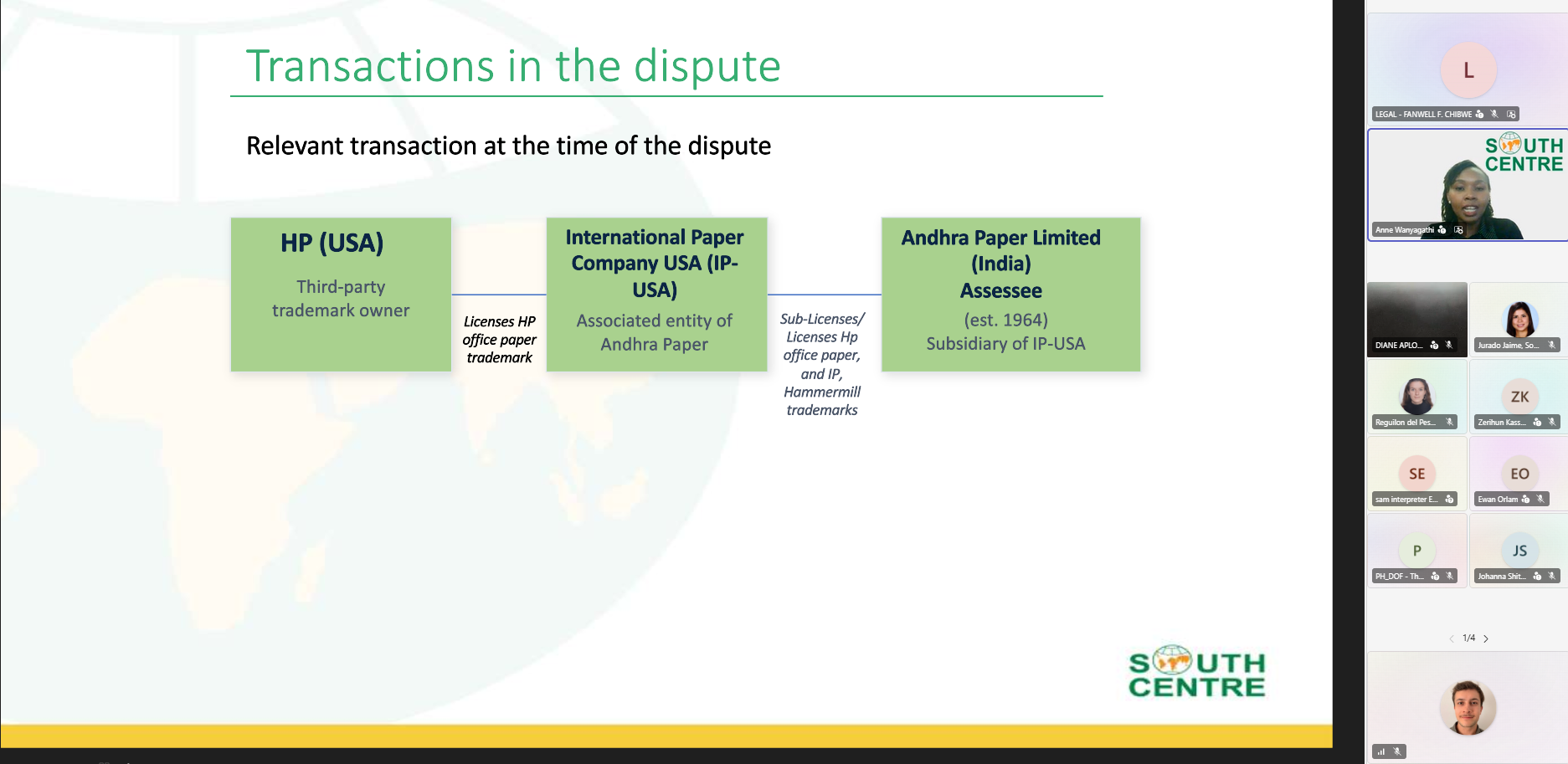
Andhra Paper Limited, an integrated pulp and paper manufacturer incorporated in India in 1964, was later acquired by International Paper Company USA (IP-USA). The company made substantial royalty payments to IP-USA for the use of trademarks on products manufactured in India — 0.5% for the IP logo, 1% for Hammermill, and 2.5%–4.5% for HP-branded office paper. For the HP-branded paper, IP-USA held a back-to-back arrangement, passing the royalty through to the third-party trademark owner (HP USA) at the same rate. When the company was selected for audit for assessment year 2020-21, it had benchmarked its royalty rates using the comparable uncontrolled price (CUP) method, drawing on the external royalty databases RoyaltyStat and ktMINE. The Transfer Pricing Officer (TPO) challenged this benchmarking — and, crucially, because the assessee also did not respond to the TPO's notices and never furnished the underlying trademark licence agreements, the TPO was able to determine the arm's length price at nil. This is a pivotal point of the case: the nil outcome was driven as much by the taxpayer's failure to engage and document as by the substance of the transfer pricing arguments.
Outcome
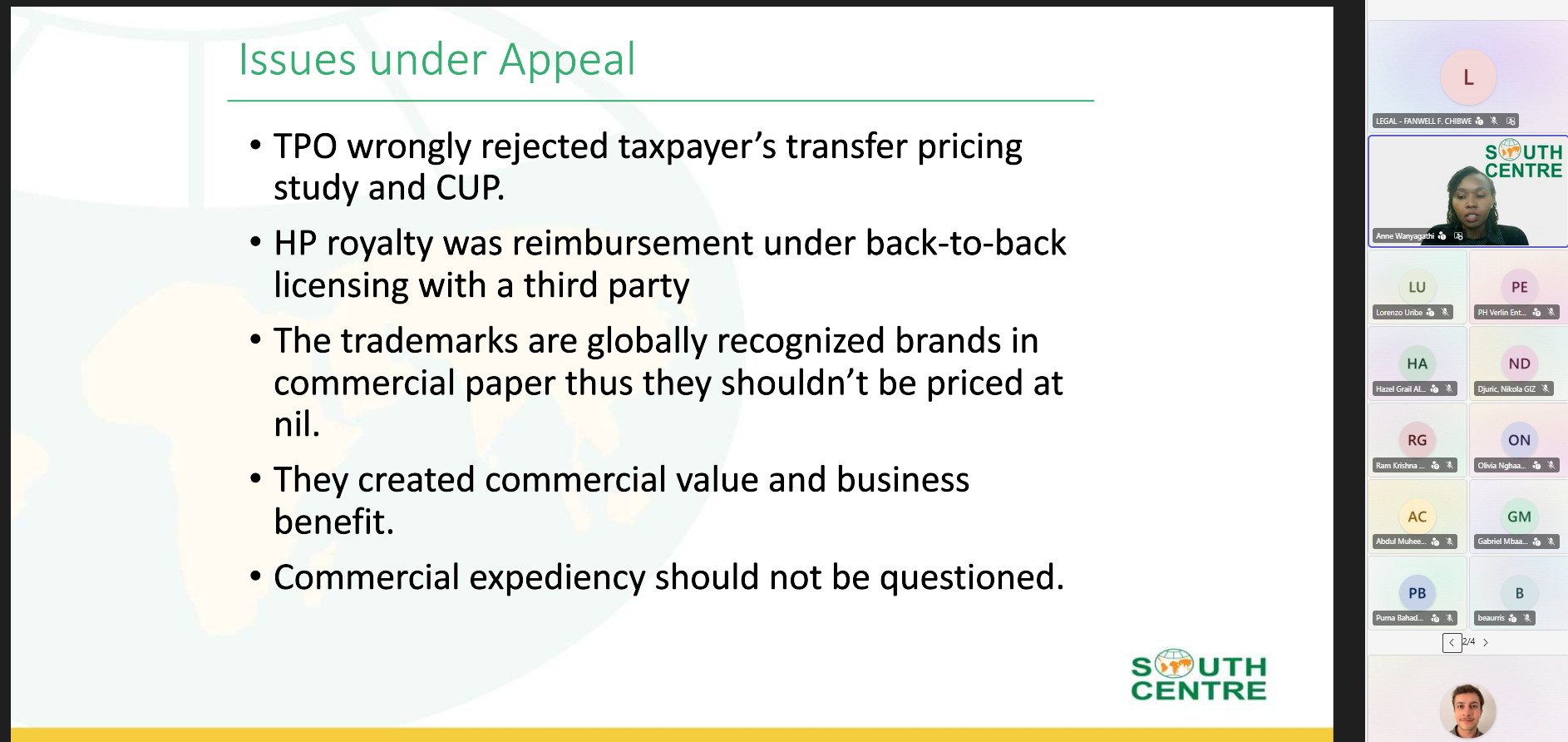
The Income Tax Appellate Tribunal (ITAT, Visakhapatnam) upheld the TPO's assessment. Its reasoning rested on several points: the comparables were drawn exclusively from US SEC filings and reflected foreign market conditions, failing the strict product, geographic and contractual comparability that the CUP method requires; the assessee failed to furnish the licence agreements needed for a proper CUP analysis; and a mere increase in sales does not, on its own, prove that the trademark generated commercial benefit. Critically, the Tribunal observed that Andhra Paper was already a significant player in the Indian market long before the foreign acquisition, whereas IP-USA's trademark had no established presence in India — suggesting the Indian company was actually building value for the foreign brand rather than the other way around. The Tribunal held that a value-chain analysis, including a functional, asset and risk (FAR) analysis connected to the DEMPE functions (development, enhancement, maintenance, protection and exploitation) for intangibles, is critical to demonstrating the arm's length nature of such payments.
Takeaways
The case confirms that tax administrations can challenge unsupported royalty deductions and shift the onus to the taxpayer to prove commercial benefit from intangibles. It underlines that an increase in sales is not sufficient evidence of benefit: Where a local company has been integrated into a group through acquisition, a comparison of pre- and post-acquisition sales could provide the necessary evidence. It also cautions that the nil determination was substantially driven by the taxpayer's failure to cooperate and furnish documentation, a reminder that procedural engagement matters as much as the substantive position.
Poll results and discussion
Two live polls situated the case within participants' own experience. Asked whether their administration had audited a royalty payment from a domestic subsidiary to its foreign parent in the last five years, a majority voted: 58% once or twice and 8% multiple times, while 8% said it was on their radar and 25% were unsure. Asked to name the single biggest obstacle they face when auditing intangibles, 38% pointed to taxpayer non-cooperation or poor documentation, followed by limited or no access to commercial databases such as RoyaltyStat and ktMINE (27%). The lack of local or regional comparables, insufficient in-house valuation expertise, and legal or procedural constraints each drew 11%. Notably, the two leading obstacles map directly onto the Andhra Paper case, where the nil determination flowed from the taxpayer's non-response and where the comparability of database-drawn comparables was central to the dispute.
The open discussion was among the most valuable parts of the webinar, surfacing questions that resonate across ATI partner-country administrations. Asked how commercial benefit can be shown when a sales increase alone is insufficient, Anne Wanyagathi Maina pointed to DEMPE analysis and transaction-specific evidence, noting that the right proof depends on the nature of the transaction. On comparables, participants asked which databases yield dependable results to which the presenter cautioned that databases populated only with US companies are ill-suited to a CUP analysis — which requires internal consistency — and that adjustments are indispensable where external data is used. A further exchange probed why the arm's length price was set to nil rather than simply adjusted downward, given the rates already appeared low: the answer tied the outcome back to the taxpayer's failure to respond and to furnish the global licence supporting the back-to-back arrangement, reinforcing that a fuller evidentiary record might have led somewhere different. Ultimately, one participant reflected that the case was an eye-opener: for a long time the assumption has been that brand value flows in one direction, from foreign parent to local subsidiary, yet here the argument that the local company was itself creating value for the trademark could not be overlooked.
Lessons for ATI partner countries
The case offers several transferable lessons for tax administrations addressing abusive transfer pricing of intangibles:
- Administrations can challenge unsupported royalty deductions and require taxpayers to prove that an intangible generates genuine commercial benefit, rather than accepting a sales increase as proof.
- The CUP method demands strict comparability of product, geography and contractual terms. Comparables drawn from foreign filings without adjustment are unlikely to withstand scrutiny.
- A value-chain analysis, incorporating a FAR analysis and DEMPE functions, is a powerful tool for testing where value in an intangible is actually created and which entity benefits.
- Well-established local companies acquired by foreign MNEs may in fact be building the foreign brand's value locally, which can reverse the assumed direction of value flow and reshape the arm's length analysis.
- The outcome reinforces the importance of documentation and taxpayer engagement: much of the assessment's strength derived from the taxpayer's failure to substantiate its position.
Next steps on the webinar series
The ATI Secretariat concluded the session by inviting participants to join the webinar series Good practices in combatting abusive transfer pricing. A summary of the first webinar will be provided to all participants via e-mail, and details of the second and third webinars will follow in due course.