© United Nations Office at Nairobi
Workstream III of the Intergovernmental Negotiating Committee (INC) on the UN Framework Convention on International Tax Cooperation (UNFCITC) is developing a protocol on the prevention and resolution of tax disputes. The draft protocol under discussion includes a range of prevention mechanisms, such as bilateral and multilateral advance pricing arrangements, cooperative compliance arrangements, simultaneous or joint tax audits, as well as dispute resolution mechanisms such as the mutual agreement procedure, mediation and conciliation, and arbitration.
Discussions to date have made clear that the effectiveness of these mechanisms depends heavily on the administrative and technical capacity available to apply them. Advance pricing arrangements and joint audits, for example, require access to comparable transaction data, transfer pricing expertise, and sustained inter-agency coordination, resources that are unevenly distributed across Member States. Several developing countries have noted that, even where new mechanisms are agreed multilaterally, their practical use will remain limited without parallel investment in institutional capacity.
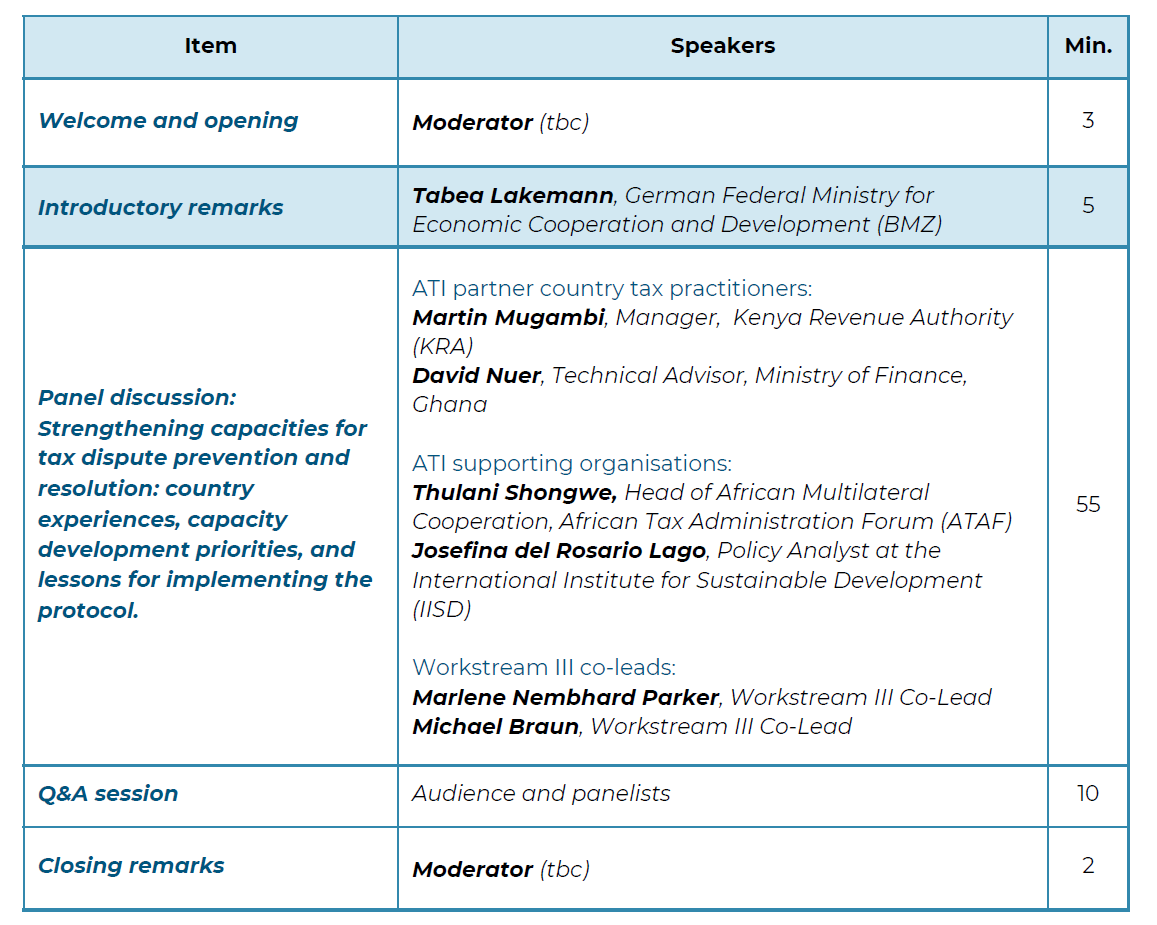
This side event aims to complement the technical negotiations by shifting the focus to implementation readiness. It would offer countries a space to identify the practical capacity constraints they face in relation to dispute prevention and resolution, and to exchange experience and explore opportunities for peer learning. It further allows development partners and supporting organisations to consider how existing and future technical assistance could be adapted to respond to those constraints, so that the mechanisms under negotiation are genuinely usable and effective once the protocol is adopted.
The Addis Tax Initiative (ATI) plays an important role in advancing fair, effective, and sustainable domestic revenue mobilisation (DRM) as a foundation for financing sustainable development. Through its Seville Declaration on DRM, the ATI brings together partner countries, development partners, and supporting organisations around a shared commitment to strengthen tax systems that are fair, transparent, efficient, and accountable, while addressing tax-related illicit financial flows. These priorities are closely aligned with the Intergovernmental Negotiations on the UN Framework Convention on International Tax Cooperation and its protocols, which aim to establish a more inclusive, stable, and effective international tax system.