
Good practices in combatting abusive transfer pricing: #1 A case from India
This case from India is the first session of a webinar series by the ATI on tackling abusive transfer pricing.
The case of India
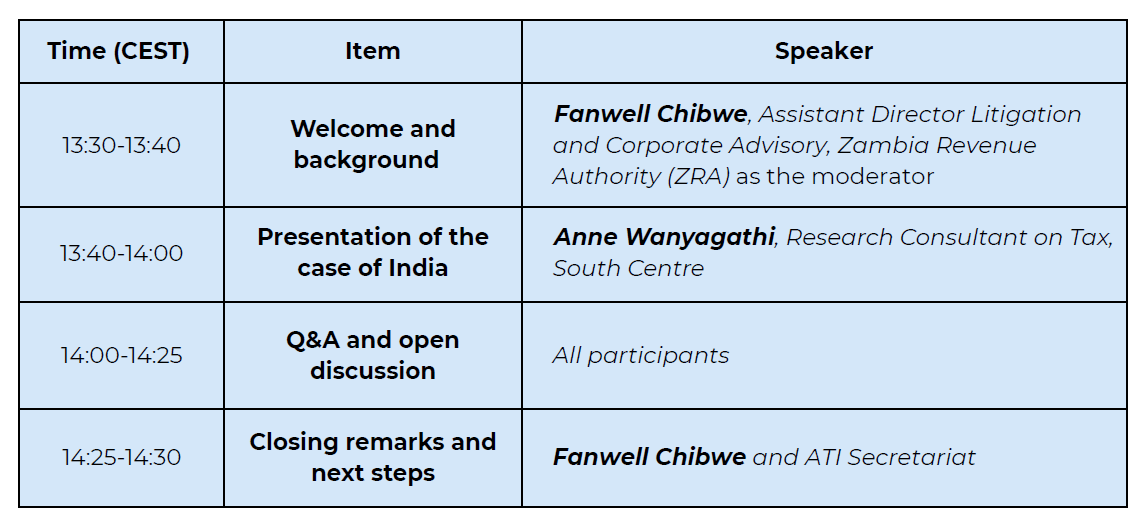
The first case study of the series is India, one of South Centre’s member countries. The case, Andhra Paper Limited v. ACIT (I.T.A. No. 349/VIZ/2024), involves base-eroding payments via royalties, namely trademark payments made to connected entities without reasonable; value-creating grounds. The assessed transactions of the company at hand, a pulp and paper manufacturer, cover the FY 19/20 and have been resolved definitively in December 2025, with the judiciary upholding the initial transfer pricing assessment – which reduced the payment to nil due to incomparability of comparable companies provided and choice of method; lack of commercial benefit obtained under the license agreement as well as failure to provide a comprehensive value chain analysis to substantiate the arm’s length principle.
Agenda
Background of the series
Transfer pricing practices play a central role in determining the allocation of taxable profits of Multinational Enterprises (MNEs) across jurisdictions and therefore have significant implications for domestic revenue mobilisation. The increasing reliance of MNEs on complex intra-group transactions, particularly involving intangibles, intra-group financing, and integrated value chains, has heightened the risk of profit misallocation and base erosion. Where transfer prices deviate from the arm’s length principle, profits may be shifted away from jurisdictions where economic activity takes place, undermining the integrity of the tax system and weakening revenue collection. These risks are especially pronounced in developing countries, where capacity constraints, information asymmetries, and limited access or availability to data on comparables can hinder effective enforcement.
Addressing these challenges requires technical expertise, strong legal and administrative frameworks, and consistent application of international audit standards. Predictable transfer pricing regimes support investment by reducing disputes and compliance risks. At the institutional level, responses often focus on capacity-building and peer learning among tax administrations. In this context, the Addis Tax Initiative (ATI) aims to promote the sharing of good practices among tax administrations to bridge capacity gaps and improve enforcement. An example of this approach was provided in a November 2025 ATI webinar with the Zambia Revenue Authority (ZRA) on the Nestlé Zambia case, which highlighted key enforcement lessons based on OECD principles and resulted in an additional tax liability of USD 3.5 million.
This webinar series falls under Action 3 of the Seville Declaration on DRM, by which ATI members commit to strengthening enforcement capacity and coordination to combat tax related illicit financial flows. In this context, the ATI continues to promote peer learning through webinars on audit practices and transfer pricing enforcement.
Objectives of the series
- Disseminate specific cases from tax authorities that demonstrate good practices in auditing and addressing abusive transfer pricing.
- Identify and analyse practical lessons across key dimensions, including policy and legal frameworks, institutional arrangements, technical methodologies, data use, audit practices, dispute resolution, among others.
- Provide actionable insights and strategic recommendations to ATI partner countries to strengthen DRM, combat tax-related IFFs, and enhance the effectiveness and transparency of tax systems, while raising awareness among ATI partner countries of the technical assistance, tools, and capacity-building support available to strengthen their capacities.