
Tax gap analysis in practice with insights from Nigeria and Brazil
The seventh ATI Tax Gap Community of Interest quarterly meeting explored how Nigeria is building institutional capacity for tax gap analysis and how Brazil is using machine learning to estimate the PIT gap and inform audit selection.
The seventh quarterly meeting of the ATI Tax Gap Community of Interest (CoI), held on 16 September 2026, featured two presentations on different aspects of tax gap analysis. Cephas Tiye from the Nigeria Revenue Service (NRS) presented the establishment of a dedicated Tax Gap Analysis Unit, its current estimation work and its links with compliance planning. Alexandre Fonseca from the Special Secretariat of Federal Revenue of Brazil - Receita Federal do Brasil (RFB) presented ongoing work on the use of machine learning for personal income tax gap estimation and audit selection.
Nigeria: establishing a dedicated Tax Gap Analysis Unit
The presentation showed how tax gap findings are intended to feed into compliance work. The creation of a dedicated Tax Gap Analysis Unit formed part of wider changes to Nigeria's revenue administration following the Nigeria Revenue Service (Establishment) Act, 2025. The reform replaced the former Federal Inland Revenue Service with the NRS and was accompanied by a restructuring of the research function. A benchmarking visit to HM Revenue & Customs in the United Kingdom also informed the design of the new tax gap function.
The presentation also explained how findings are intended to move through the administration. Tax gap findings feed into the NRS Risk Management Department, which incorporates them into the Compliance Improvement Plan. The results then inform audits, enforcement and other operational responses. The estimate therefore has a route through the organisation rather than ending as a standalone analytical product.
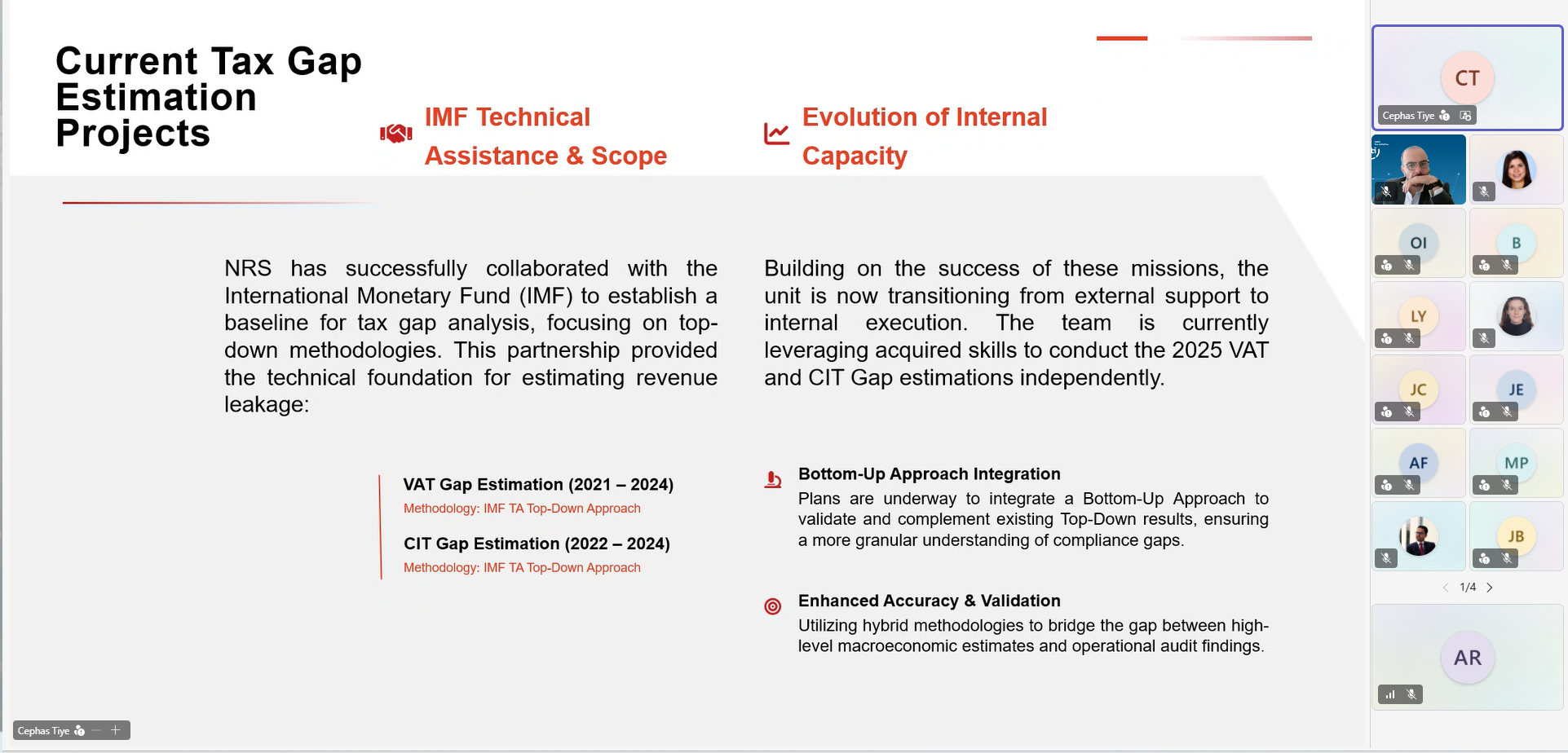
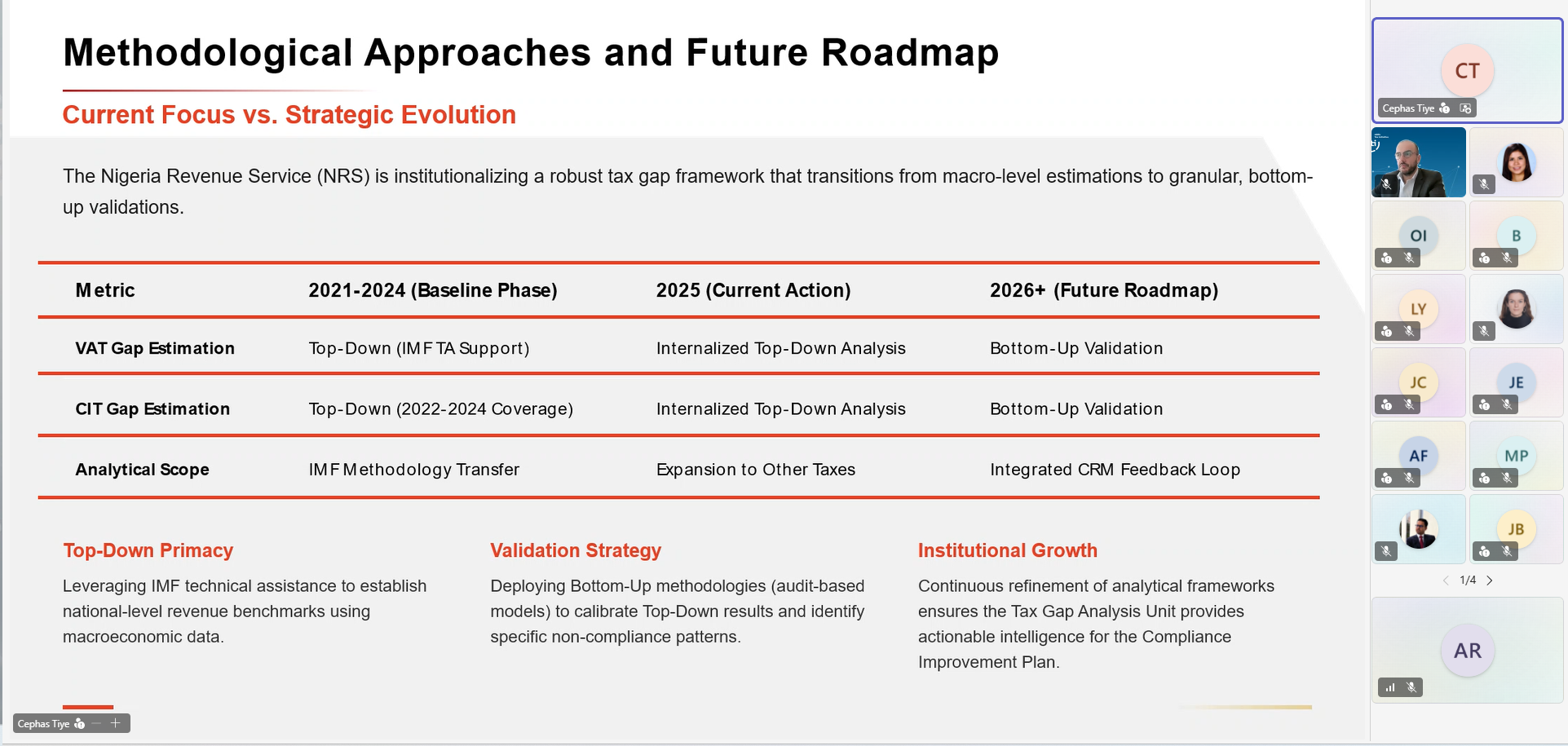
Nigeria began developing this capacity with technical assistance from the International Monetary Fund. The initial work established top-down estimates for the value-added tax gap for 2021–2024 and the corporate income tax gap for 2022–2024. NRS staff are now using the knowledge gained from those exercises to conduct the 2025 estimates internally. The next planned step is to add a bottom-up perspective to their estimates.
During the discussion, NRS representatives explained that top-down approaches provide a broad picture of the gap, while bottom-up analysis can potentially show where exactly that gap is concentrated. This could allow the administration to distinguish, for example, between risks associated with different taxpayer segments or sectors. The NRS plans to use bottom-up work to complement and validate the existing estimates.
Accessing and linking the data
The discussion also turned to the data needed for more detailed tax gap analysis. NRS representatives elaborated on the practical difficulty of working with information held across different institutions and systems. During earlier tax gap exercises, some datasets had to be obtained externally and prepared before they could be used together.
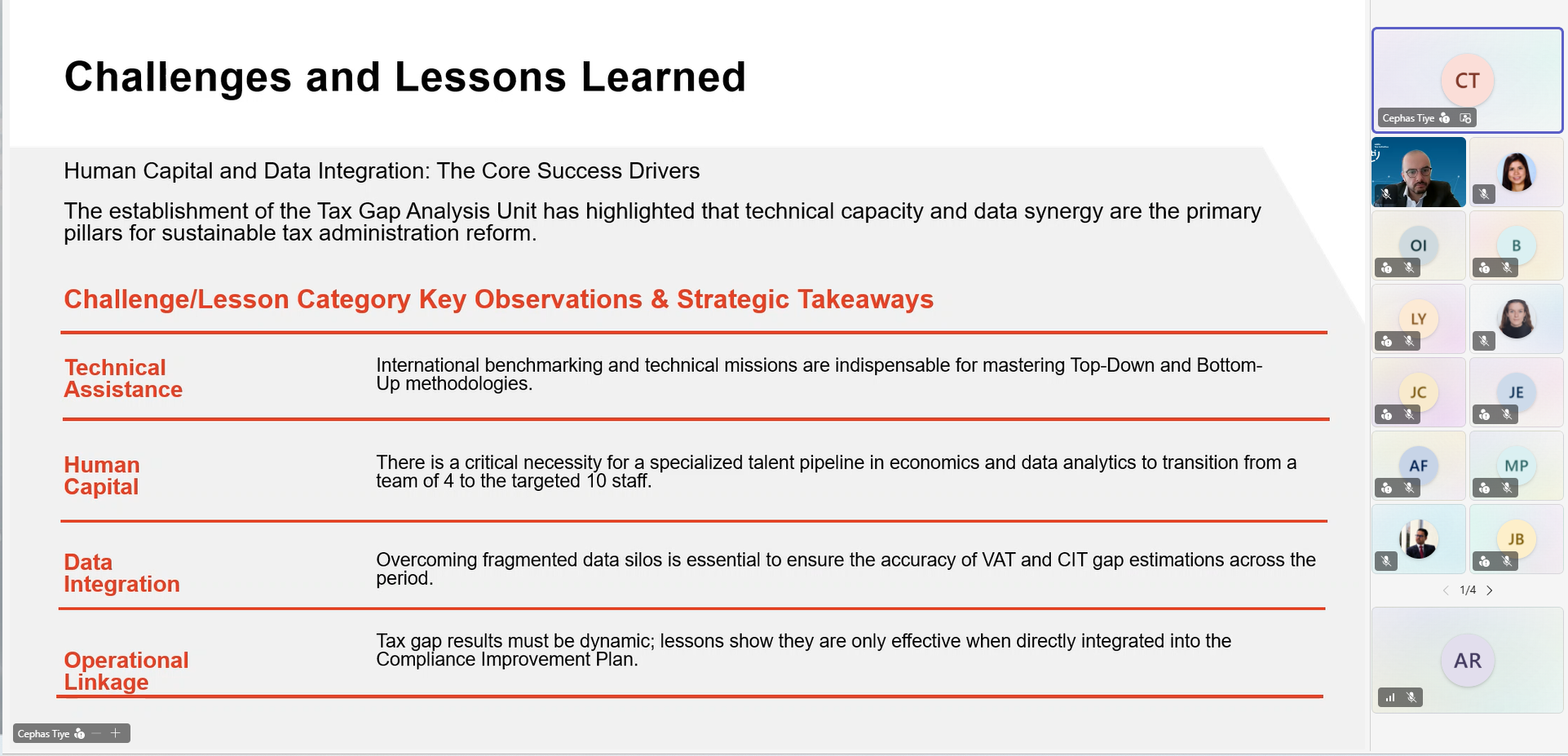
The NRS is now developing an intelligence environment intended to bring internal and external information into one place. During the meeting, the presenters also referred to e-invoicing and trade-related information as sources that could strengthen this database. The NRS presentation identified data integration, specialised expertise and links with operational functions among the main challenges and lessons from establishing the unit.
Brazil: machine learning for PIT gap estimation and audit selection
The RFB presentation then turned to a more specific methodological question: how can administrative data and machine learning be used for PIT gap estimation and audit selection?
Brazil receives around 40 million electronic PIT returns, but existing audit data create a problem for conventional tax gap modelling. Review audits are numerous but largely concern deductions and are not suitable for estimating the broader gap. Regular audits contain richer information, but their number is too small to provide a sufficiently large training sample for a standard machine-learning exercise.
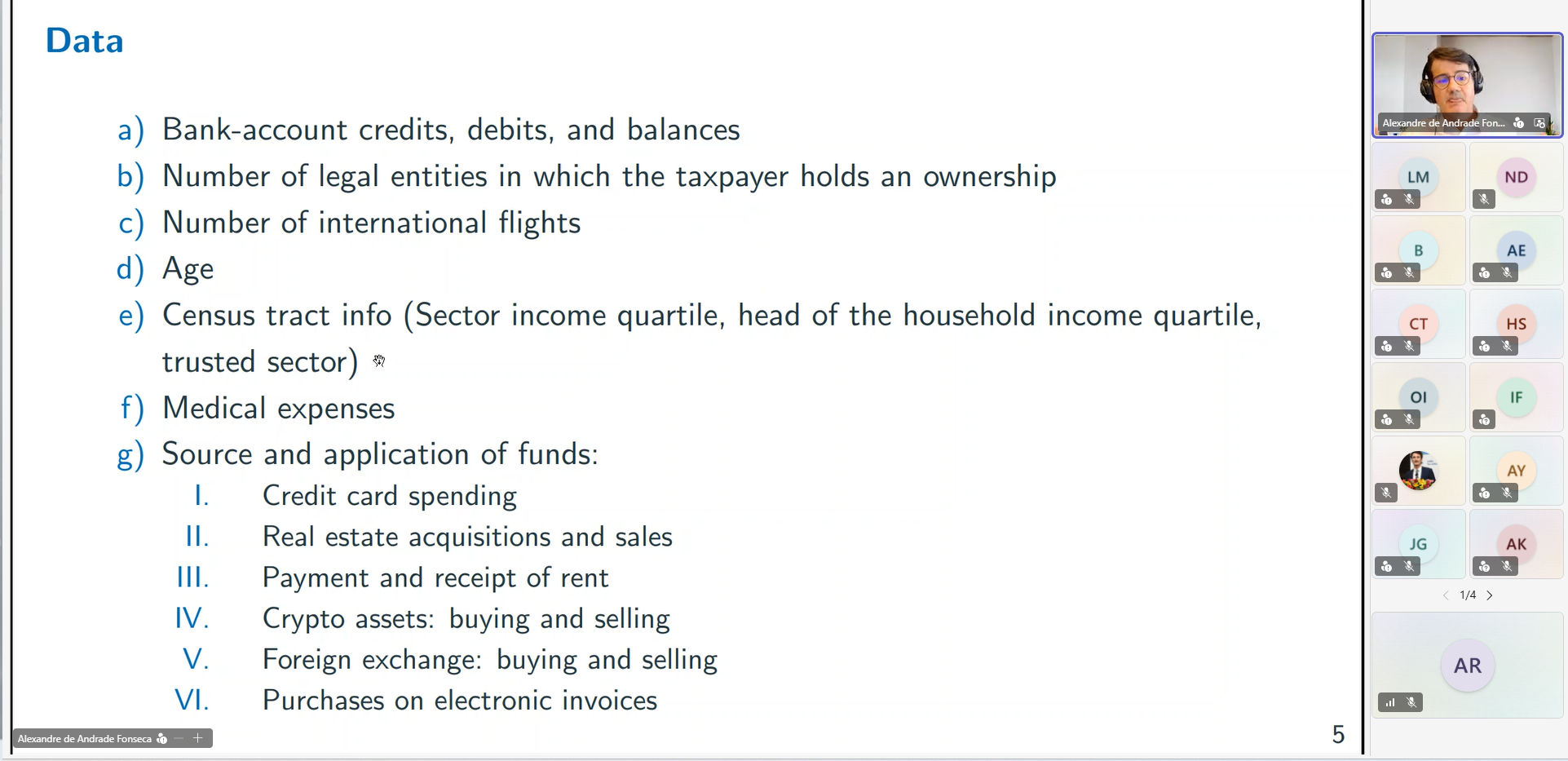
The model therefore uses a range of administrative and socio-economic information, including financial transactions, property-related information and electronic invoices. Data from electronic PIT returns are not used as model inputs, while audit data are reserved for evaluating how well the model performs.
The researchers did not begin with classification. They initially tried to predict income directly using several regression models, including random forest and XGBoost. Those approaches struggled, particularly with higher-income taxpayers. The problem was then reformulated. Instead of estimating an exact income, the model predicts the probability that a person belongs to one of five income groups, including a separate category for the top 1% of incomes.
The application presented at the meeting used data from Belo Horizonte. Around 760,000 people filed PIT returns there in 2022, while approximately 1.1 million adults did not.
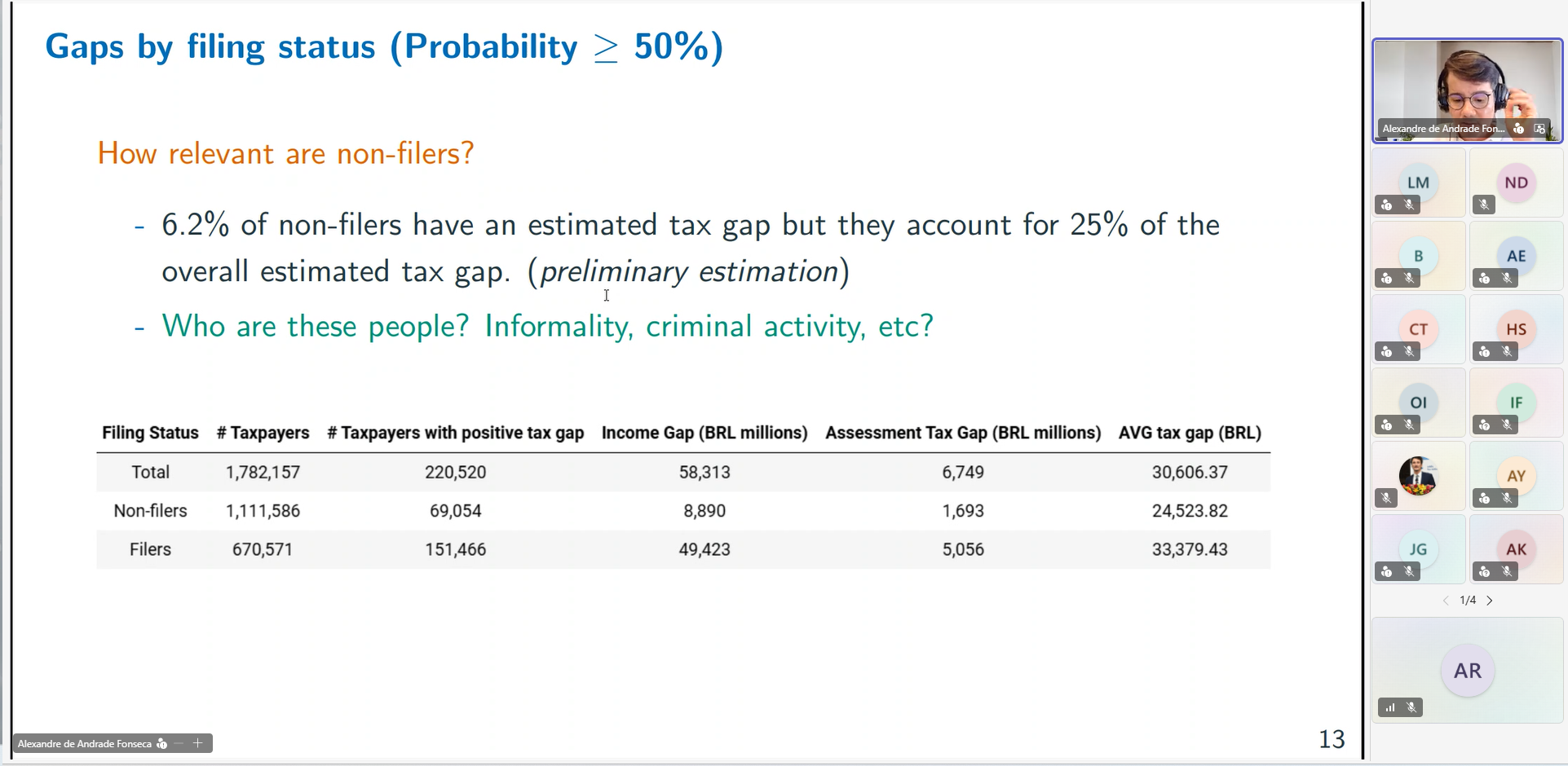
The inclusion of non-filers was particularly relevant. An approach based only on submitted returns starts with people who are already visible to the tax administration. The Brazilian model also asks whether a potential gap may lie outside that filing population. Only 6.2% of non-filers in the analysed population were estimated to have a tax gap, but they accounted for 25% of the overall estimated gap.
The team also evaluated the model against actual audit results. For 160 taxpayers audited exclusively for the 2022 tax year, the presentation reported 78% pre-audit accuracy and 96% post-audit accuracy at a 90% probability threshold. The presentation also showed how the model could be used to support audit selection.
When a tax gap becomes a risk signal
The Brazilian team also used the model to build taxpayer risk profiles, combining the estimated probability of a gap with its potential value. Among 168 taxpayers in one high-risk group, 88% had recorded expenses exceeding their declared income, while 84% had bank-account credits at least ten times higher than their declared income.
Although these patterns are not proof of non-compliance, they are signals that can help an administration decide which cases deserve further examination.
The Brazilian team is now developing a nationwide model for tax year 2025. The planned application would cover around 40 million filers and 118 million non-filers across 428,000 census tracts, for use in the RFB's audit-selection process.

Links of interest
ATI Tax Gap Community of Interest: Quarterly Meeting VII | ATI
ATI Tax Gap Community of Interest: Quarterly Meeting VI | ATI